 Bullseye
Solve
Firing solutions
Elevation and windage in MOA or mil, from G1 or G7 drag. Spin drift is applied for you. Coriolis uses your GPS latitude and a compass bearing.
Bullseye turns your rifle data and the conditions on the ground into elevation and windage you can read at a glance. It takes live wind and weather from your Bluetooth sensors, and it logs every shot so you can see how your dope holds up.

.308 Win, 175 gr SMK, G7 0.243, 2,610 fps, 100 yd zero, 59 °F at sea level, 10 mph from 3 o'clock. Windage includes spin drift. Solved by the app, as on the range screen above.
Build a profile once. Bullseye solves the shot with a full point-mass engine and keeps a record of what actually happened.
Elevation and windage in MOA or mil, from G1 or G7 drag. Spin drift is applied for you. Coriolis uses your GPS latitude and a compass bearing.
Connect several Bluetooth sensors at once. Wind, temperature, pressure and humidity feed one live solution.
Enter what you really dialled at two known distances. Bullseye adjusts muzzle velocity and drag to match your rifle.
Say "hit" or "miss, one mil low" and the shot is logged. Track your hit rate by distance.
Photograph the target, then mark two reference points, your aim point and the holes. Bullseye measures the group and how far its centre is from your aim.
Record charge ladders and seating tests with velocity and group size per rung. Turn the best rung into a load.
Build the stage list, then step through it on the day. Each target's dial is ready, and every shot you log is tagged with its stage.
Rounds count as you log shots. See barrel life left, and turn on a reminder for when a clean is due.
Enter your load's velocity at two or more temperatures. The solution follows the ammo temperature on the day.
Big numbers and high contrast, so the dial reads at a glance.
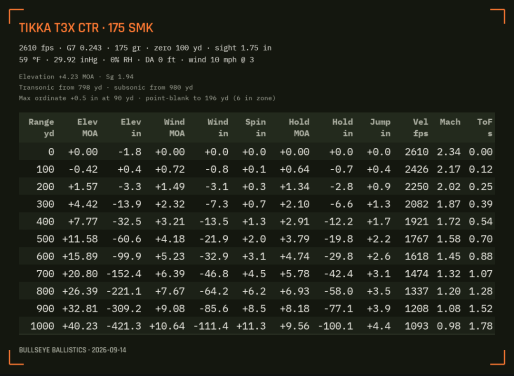
A full dope table for the load. Share it as an image or as text.
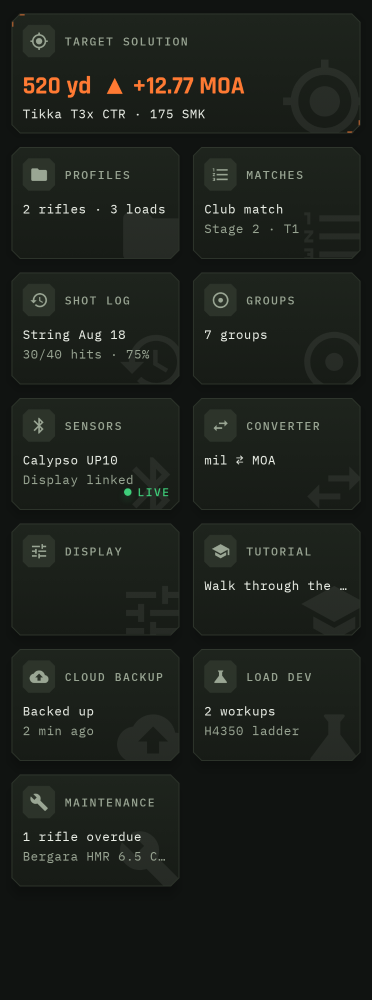
Each tile shows where you left off.
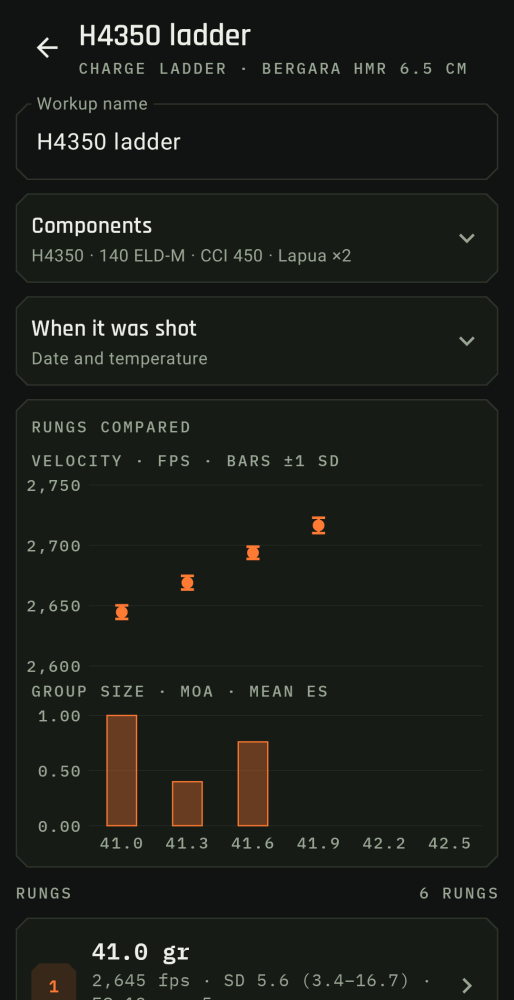
Velocity and group size for every rung.
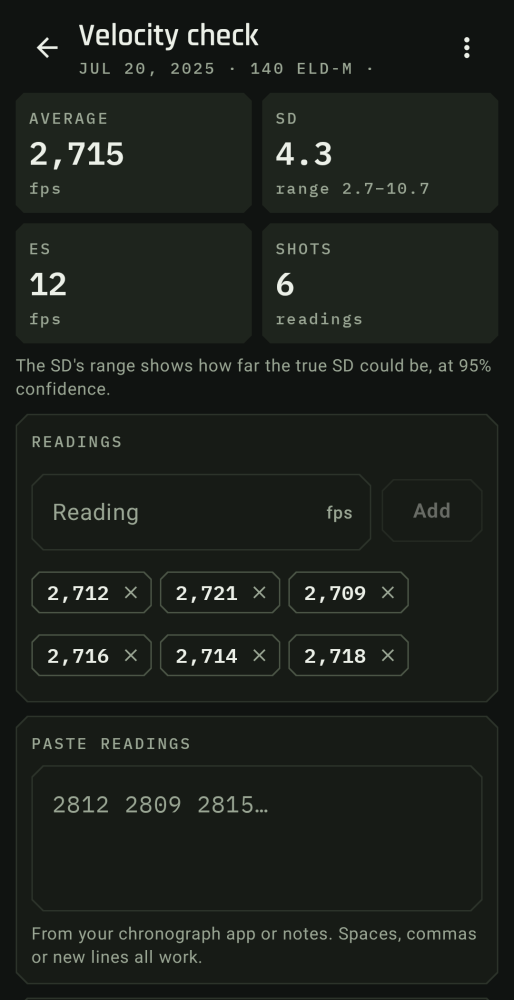
Average, SD and ES from your chronograph readings.
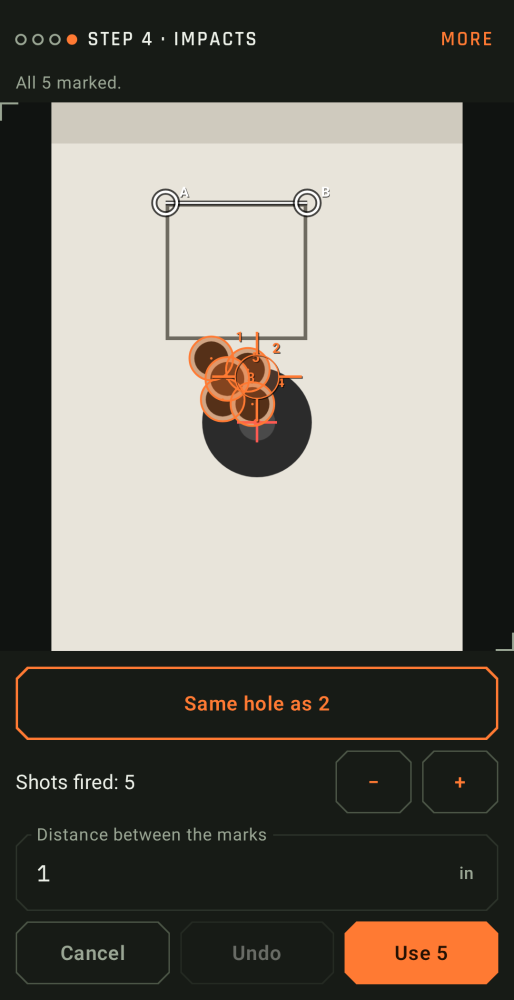
Mark the holes on a photo and get the size.
Use more than one at a time. Pick which sensor supplies each reading.